

TL;DR
- Choose Apollo when a small sales team needs to find people and run outbound from a shared sales platform. Its current offer includes enrichment and agent features alongside prospecting and execution.
- Choose Clay when the team needs to compose research, enrichment and qualification into repeatable GTM logic. Coding agents can now work through its plugin, CLI and API. A human-only spreadsheet comparison misses that architecture.
- Choose ZoomInfo when a scoped enterprise intelligence purchase earns its cost on your named accounts. Do not use a guessed annual entry price or global record count to justify the contract.
- Compare accepted contacts and operating work, not claimed database accuracy. There is no documented head-to-head trial in this article establishing a universal coverage or deliverability winner.
- Specialist enrichment providers can fill a narrower gap. Keep their subscription, field charges and maintenance separate from the platform they complement.
Clay vs Apollo vs ZoomInfo: Overview
The useful distinction is who owns the operating workflow. Apollo brings prospecting and outbound execution together. Clay lets an operator assemble provider data, research and rules into a repeatable process. ZoomInfo is an enterprise intelligence and workflow purchase whose value depends on the licensed modules and target market.
These boundaries overlap. Apollo's current product and pricing page includes waterfall enrichment, AI assistance and programmable product surfaces. Clay's current developer documentation includes account searches, functions and coding-agent workflows. Neither should be reduced to the narrower product it was several years ago.
| Decision | Clay | Apollo | ZoomInfo |
|---|---|---|---|
| Main buying reason | Compose specialist data and judgement into repeatable GTM logic | Prospect and execute outbound in a sales workspace | Procure a scoped enterprise intelligence and activation package |
| Operating owner | GTM operator or engineer maintaining the workflow | Sales operations and the sellers using the platform | Enterprise data, sales operations and procurement |
| Data evaluation | Selected provider mix and research contract | Purchased data and enrichment rights in the chosen tier | Contracted territories, fields, modules and delivery rights |
| Important extra costs | Provider/model use, implementation and maintenance | Credits, add-ons, administration and account limits | Modules, seats, exports/API delivery and rollout |
| Weak fit | No owner for custom logic or exceptions | A highly specialised workflow that requires extensive external orchestration | A narrow, low-volume job that cannot justify the proposal |
A team can use more than one. The second platform needs a bounded job, however. Buying Clay beside Apollo to enrich only missing approved fields is coherent. Giving both systems unrestricted ownership of the same CRM fields creates avoidable conflicts.
Data Quality and Coverage Compared
Raw size does not answer whether a provider reaches the people you sell to. A large database can contain the wrong subsidiary, old employment, a switchboard where a mobile is needed, or an email whose technical verification says little about buying relevance.
No common current sample, date, geography and acceptance rule establishes a universal accuracy winner here. Waterfall enrichment can find additional records, but the number of providers does not guarantee correct identity or better campaign results.
Use the same named-account sample across the options. Include your difficult territories and roles, and distinguish these outcomes:
| Outcome | Acceptance question |
|---|---|
| Account match | Is this the correct operating or legal entity? |
| Current employment | Does the person still work at the target account? |
| Email result | Is it the required work address and verification state? |
| Phone result | Is it a mobile, assigned direct dial or generic office number? |
| Supporting evidence | Can an operator inspect the source and date? |
| Licence | Is the proposed export, API or client use permitted? |
For example, start with 200 contacts already identified by your team. Report accepted records by market rather than pooling them into one impressive percentage. A source providing 90 usable records in one territory and ten in another may be useful for only part of the programme. Preserve rejected and untested records so the denominator cannot quietly change.
Treat a provider confidence score as evidence about its matching system. It is not independent confirmation that the CRM account, employer and contact channel are correct. The direct-dial data guide develops the phone-specific acceptance rule.
Enrichment Capabilities
Clay's strength is composition. Its marketplace, research functions and workflow logic allow the team to choose providers and apply business rules before handing records downstream. The current plugin installs Clay skills and its CLI into a coding-agent environment; the API provides a separate background-job route. Equivalent operations still consume the corresponding credits and Actions. MCP for Reps is a separate connection, not automatically installed by the plugin. Clay interface documentation.
The table API is read-only. Basic reads are documented across plans; structured queries require Enterprise table sync. Workflows are documented as Beta, with managed and custom functions recommended as the more stable production route. These boundaries matter to an engineer planning to create an entire operating workspace through the API. A callable function and a collaborative table are different interfaces.
Apollo's strength is proximity to execution. Its current plan comparison includes data filters, sequences and enrichment capabilities alongside AI assistance. A seller can use the same account context to find contacts and progress outreach. Inspect the chosen tier's credit schedule and the particular enrichment path before assuming that its subscription includes every data operation. Apollo pricing and capabilities.
ZoomInfo's strength must be scoped to the enterprise purchase. Evaluate company intelligence, contact fields, account research, intent or workflow modules against the sales motion and contract. A module appearing in the wider product family is not proof that it is included in the proposed order. Its pricing route is the starting point for that proposal; this review did not obtain a public, account-specific price.
For all three, define overwrite rules. Fill a missing field, replace a field because fresher evidence exists, and record a research hypothesis as a note are different operations. The seller's manually confirmed contact should not be replaced just because another provider returned a non-empty value.
Pricing Comparison (2026)
The following public purchasing references were checked on 6 October 2026. They are not equivalent bundles or negotiated quotes.
| Platform | Purchasing reference | What to add to the comparison |
|---|---|---|
| Clay | Launch from $185/month; Growth from $495/month on the monthly plan references | Actual Data Credits and Actions, provider keys, models, required integrations and operating time |
| Apollo | Basic $49, Professional $79 and Organization $119 per seat/month, billed annually; Organization minimum three seats | Credit allocation, field and operation charges, add-ons, minimum seats and actual billing commitment |
| ZoomInfo | Scoped proposal; no verified universal entry figure used here | Licensed product, users, territories, export/API rights, modules, implementation and renewal terms |
Clay plan reference, Apollo plan comparison. Annual equivalents should not be presented as monthly cancellation rights. Organisation at three seats has a published reference of 3 × $119 = $357/month equivalent, or $4,284 annually, before additional consumption or services.
Consider a hypothetical team of three using Apollo Professional plus Clay Growth. The reference subscriptions are 3 × $79 + $495 = $732/month equivalent. Apollo contributes an annual commitment while the Clay figure here uses its monthly reference. If the combined workflow costs another assumed $100 in external use and four operator hours at $60, total monthly planning cost is $1,072. At an assumed 800 accepted contacts, that is $1.34 each.
This is a budget illustration, not a measured yield or a claim that the combination beats ZoomInfo. At 400 accepted contacts, the same spend is $2.68 each. If the team already owns Apollo, also show the incremental cost of adding Clay: $495 plus its attributable usage and maintenance. A full-stack allocation and an incremental purchase answer different questions.
The right denominator is the output needed by the business. An email-only batch, a verified mobile list and a source-backed enterprise account brief have different costs. Put the acceptance rule in the Clay Waterfall Enrichment Guide before estimating provider order and credit consumption.
Prospecting and List Building
Apollo is a practical starting point when the team needs filters, saved prospects and outbound activity in one place. Confirm the selection and export limits of the intended tier, then use a representative account list to assess current employment and field quality. The presence of a contact in a search does not mean every desired field is included without another charge.
Clay supports searches over its GTM data as well as provider integrations. Its advantage appears when discovery needs a custom definition: a particular operational signal, source-backed research question or qualification rule that ordinary database filters do not capture. Someone must maintain that definition and inspect exceptions.
ZoomInfo belongs in the trial when the team needs enterprise account depth and can use the contracted intelligence throughout its sales process. Ask the vendor to demonstrate the actual account set, then examine how the seller uses the results. A detailed hierarchy is valuable only when it changes account coverage, ownership or an informed conversation.
Avoid purchasing several databases upfront because each advertises incomplete coverage. Begin with a primary source, then test a second provider only on records that remain missing under the same acceptance rule. Measure additional accepted contacts, not the second provider's standalone hit rate on easier records.
Which Platform Fits Your GTM Stack
| Operating situation | Starting recommendation | Reason to change it |
|---|---|---|
| Founder or small team testing a repeatable outbound motion | Apollo's bounded free or suitable paid tier | The research or enrichment policy becomes more specialised than the native workflow |
| GTM operator joining sources, signals and qualification rules | Clay with a deliberately chosen provider set | Maintenance, credit consumption or collaboration requirements do not fit the team |
| Enterprise team procuring account intelligence across several markets | Trial ZoomInfo against the named accounts and competing data sources | The licensed intelligence does not produce enough accepted seller use to justify the contract |
| Team already owning a functioning platform | Repair the specific data or handoff gap first | A measured pilot establishes that replacing the operating platform is worthwhile |
Use an existing CRM as the identity anchor. Keep account and person IDs stable across exports, and attach source evidence to the qualification record. Sequencing should receive an approved contact and the actual reason for outreach, rather than a fresh AI paragraph with no source.
For a narrower platform decision, the Clay versus Apollo guide examines the operating trade-offs in more detail.
Our Recommendation by Company Stage
Use stage as a proxy for operating needs, not a rigid revenue threshold. A small industrial supplier selling into complex enterprise accounts can need more account research than a much larger company with a simple inbound motion.
For a founder-led programme, start with the least expensive workflow that produces credible conversations. Apollo is worth considering because sourcing and execution are close together. Keep a record of rejected contacts and useful replies before adding another system.
For an established team with a GTM operator, add Clay when a specific qualification or provider workflow earns its maintenance cost. The reason should be concrete: missing contact channels, source-backed account research, territory-specific enrichment or an inspectable rule that native filters cannot express adequately.
For an enterprise account programme, assess ZoomInfo as a contracted intelligence package rather than an automatic graduation after an ARR threshold. Compare its named-account coverage, seller adoption and permitted delivery with the cost of the workflow already in use. Keep the products whose information changes sales decisions.
Seven Specialist Alternatives
These are narrower buying routes, not seven products declared superior to the three platforms. Prices and details refer to the public sources checked on 6 October 2026; live cards can change. Each option must earn a role in the required workflow.
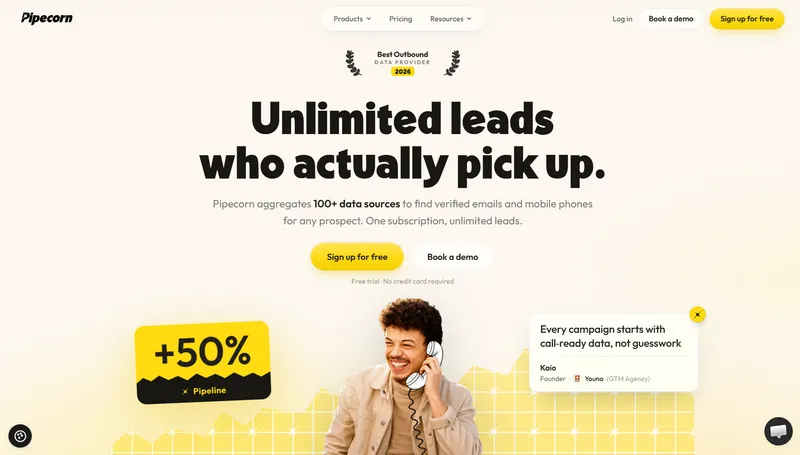
1. Pipecorn: shared enrichment and prospecting
Pipecorn combines a contact workflow with waterfall enrichment. Its current pricing matrix meters emails and phones differently: one verified email uses three credits and a mobile uses thirty. Paid workspace seats are included. That can be attractive when a growing team mainly needs shared data access rather than a bespoke research application.
The public calculator and base matrix show different selected-volume totals, so use the configuration actually being purchased. A lead with both fields uses 33 credits; 500 such leads require 16,500 credits before other operations. The extension page also contains unlimited-enrichment language that does not match the pricing matrix. Retain that conflict for order confirmation, rather than presenting unlimited use as established.
Fit: a team wanting a shared enrichment purchase and defined field budget. Non-fit: a workflow whose expert qualification logic needs broader orchestration than the documented product provides.
2. Datagma: a focused mobile fallback
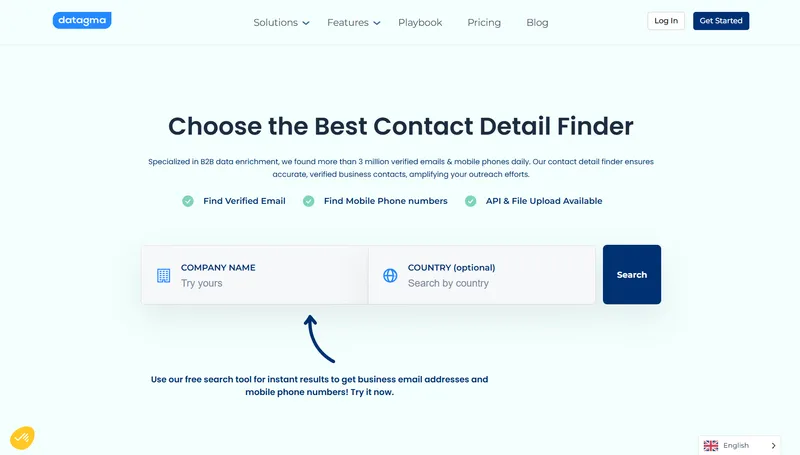
Datagma's Phone Finder positions a person-mobile lookup rather than a replacement for the whole sales workspace. The phone-page references include $79 for 250 found phones and $209 for 750, with billing terms requiring checkout confirmation. Its published France-based mobile exclusion matters to a European programme more than a generic global-coverage claim.
Fit: filling missing mobiles from reliable person identifiers in supported markets. Non-fit: needing a complete collaborative account-research and sequencing environment. Pay-on-found billing still requires independent correct-person review.
3. Findymail: finding and verifying contact channels
Findymail's pricing page lists Starter at $99/month for 5,000 finder credits and bonus verification credits. An email uses one finder credit; a phone uses ten. A hypothetical mixed batch of 1,000 emails and 200 phones uses 3,000 finder credits, before other lookup operations. Keep external-address verification separate from finding new contacts.
Fit: an existing research or sales platform needs additional verified fields. Non-fit: expecting a finder subscription to replace account qualification, CRM ownership or outbound execution. The vendor's deliverability guarantees are terms to inspect, not independent accuracy results for this comparison.
4. BetterContact: a small waterfall entry
BetterContact publishes Starter at $15/month with 200 credits, enough for 200 email results or 20 mobile results at its stated one-versus-ten credit schedule. It combines provider lookup and verification, with API and integration routes. That is a useful initial budget for a narrow missing-field pilot.
The current page distinguishes Starter, Pro and Enterprise, including catch-all and phone-verification treatment. Own-key terms also differ between the feature cards and comparison matrix. Confirm the purchased tier or add-on before subtracting a provider licence from the budget.
Fit: testing incremental field coverage without buying another large platform. Non-fit: needing every provider-specific response or a complete expert research operating surface.

5. FullEnrich: a dedicated waterfall purchase
FullEnrich belongs in an evaluation where the job is enriching identified contacts through multiple sources. Assess its input requirements, returned verification states and successful-result credit schedule on the same missing-contact sample used for the alternatives. CSV and API purchasing requirements should be priced around the intended deployment.
The public pricing calculator, checked on 6 October, shows a selected 1,000-credit monthly reference at $0.055 per credit, or $55. Confirm the displayed currency, billing term and selected volume at checkout. Its published units are one credit for a work email, ten for a mobile number, three for a personal email and one for reverse-email enrichment. A successful work-email-plus-mobile request therefore uses eleven credits; 1,000 credits cover at most 90 such complete pairs, before other charged operations. Profile/company data costs 0.25 credits when requested alone and is included with enrichment. Unlimited users, API and CRM integrations are listed, but those do not remove the need to check the destination mapping and permitted use.
Fit: a specialised waterfall alongside an existing CRM or sequencing system. Non-fit: assuming a contact-data waterfall also supplies the account judgement, collaboration and handoff logic of a full GTM platform.

6. AI Ark: self-serve discovery and export
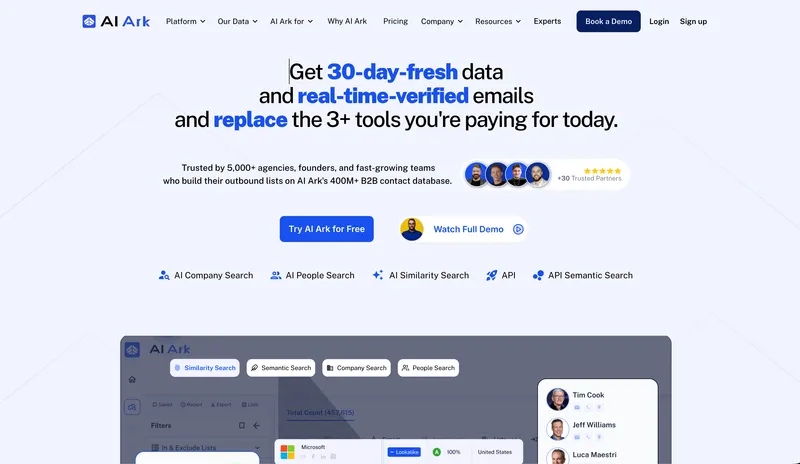
AI Ark's public pricing lists a free 100-credit monthly route and a $49/month usage package with 5,000 credits. Its calculator charges different operations, including storage, valid-email finding and mobile lookup. Do not divide the subscription by 5,000 and call that the price of a complete exported contact.
The vendor describes verification at export and lookalike search. Those are useful product mechanisms, not proof of a universal bounce rate or superior coverage. Its page describes native CRM connectors as a roadmap item, with CSV/API handoffs in the current offer.
Fit: a team wanting self-serve account/contact discovery with an explicit operation budget. Non-fit: requiring a confirmed native CRM implementation or taking advertised verification quality as independent validation.
7. Freckle: table-based enrichment with an output budget
Freckle's current pricing lists 250 free credits and Build from $99/month, with table, waterfall and web research capabilities. Build lists HTTP API and own-key support.
The extracted matrix does not clearly establish every integration entitlement, and several FAQ answers are placeholders. Do not infer free native CRM sync or a universal five-credit phone tariff from that incomplete page. Confirm the selected connector and provider-specific output cost before modelling production use.
Fit: a team evaluating a managed enrichment workspace with a defined output budget. Non-fit: buying an unverified integration or comparing credits across providers as though they represent identical work.
FAQ
Can I use Clay and Apollo together?
Yes. Give each a specific job: Apollo may own prospecting and outreach, while Clay fills approved missing fields or applies an account qualification rule. Avoid enriching every contact twice or letting both overwrite the same CRM value. Compare incremental accepted output with the second subscription and operating time.
Is ZoomInfo worth the price for a SaaS startup?
It depends on the sales motion and proposal. A small team with complex enterprise accounts can have a reason to evaluate it; a large team doing simple low-value outbound can still find it excessive. Test the named accounts, required modules and seller use. This article does not establish a universal annual entry price or an ARR threshold that decides the purchase.
Which tool has the most accurate email data?
No common current trial in this article establishes that winner. Use the same people, markets, verification policy and research date. Report current-employment errors, missing fields and untested outputs alongside technical email status. More provider matches do not automatically mean more accepted contacts.
Which platform should I start with if I've never done outbound?
Start with a bounded prospecting and execution workflow, often Apollo's appropriate free or paid tier, and verify a small relevant contact set. Add specialised orchestration when a concrete research or data gap appears. The first purchasing objective is a repeatable useful sales conversation, not the largest stack.